UFEMISM Weekly Benchmarks

Repository: UPSY-group/UPSY-models
Run number: 72
Run ID: 45181861452
Commit: 26a406b6fe13

Halfar dome

Fig_integrated_test_Halfar_dome_full
Fig_integrated_test_Halfar_dome_full.png

Keywords

Description

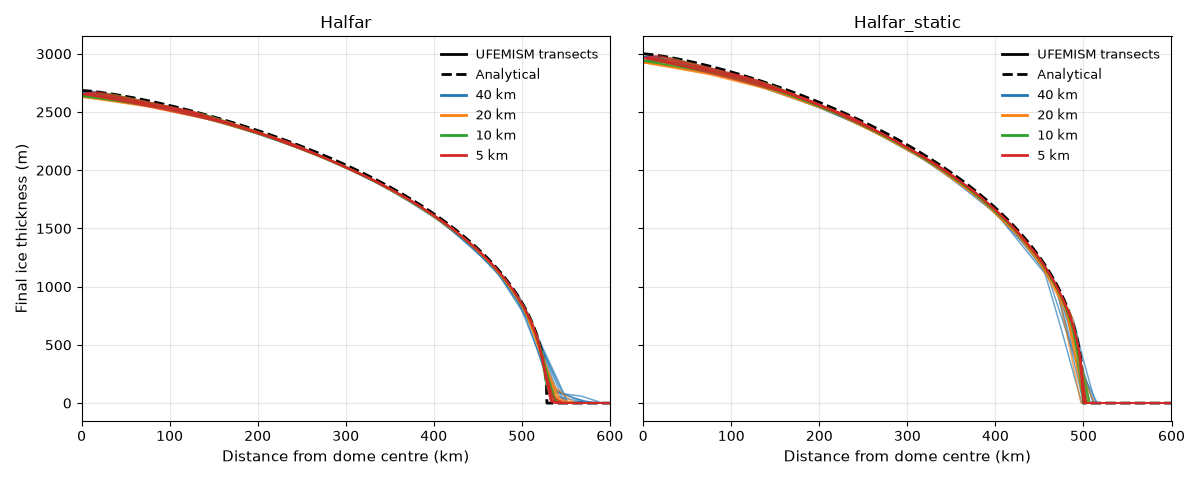
The Halfar solution to the SIA gives the ice thickness H(x,y,t), given a specific initial ice geometry H0(x,y). This is a great tool for verifying the ice thickness integration module. The Halfar_static experiment imposes an SMB that is exactly equal and opposite to the thinning rate dH/dt of the Halfar solution, so that the ice thickness ideally should not change at all.
MISMIP+

Fig_integrated_test_MISMIPplus_full
Fig_integrated_test_MISMIPplus_full.png

Keywords

Publications

Description

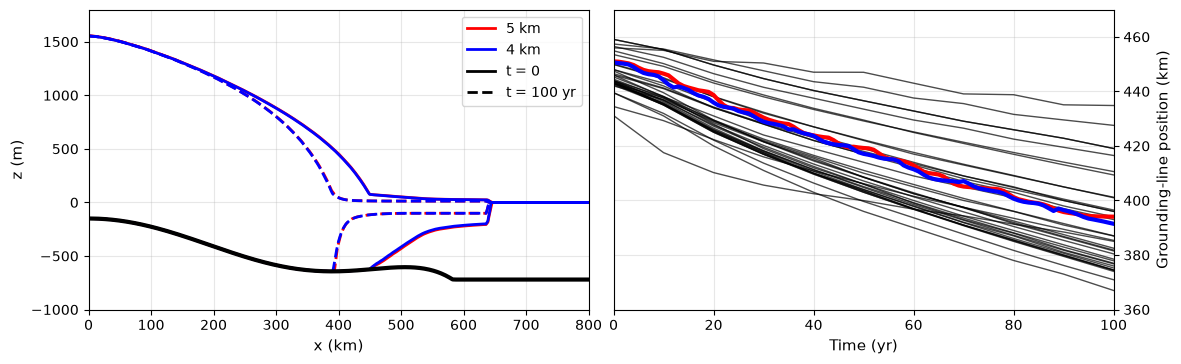
MISMIP+ describes a large ice stream flowing down a laterally symmetric valley, into a confined embayment. In the initial steady-state geometry, the grounding line rests on a retrograde slope, and is kept in place by a strongly buttressing shelf. In the ice1r retreat experiment, a warm ocean is prescribed, causing the shelf to thin and the grounding line to retreat. In the test, we directly compare UFEMISM's modelled grounding-line position over time to the model ensemble by Cornford et al. (2020).

MISMIP_mod

Fig_integrated_test_MISMIP_mod_full
Fig_integrated_test_MISMIP_mod_full.png

Keywords

Publications

Description

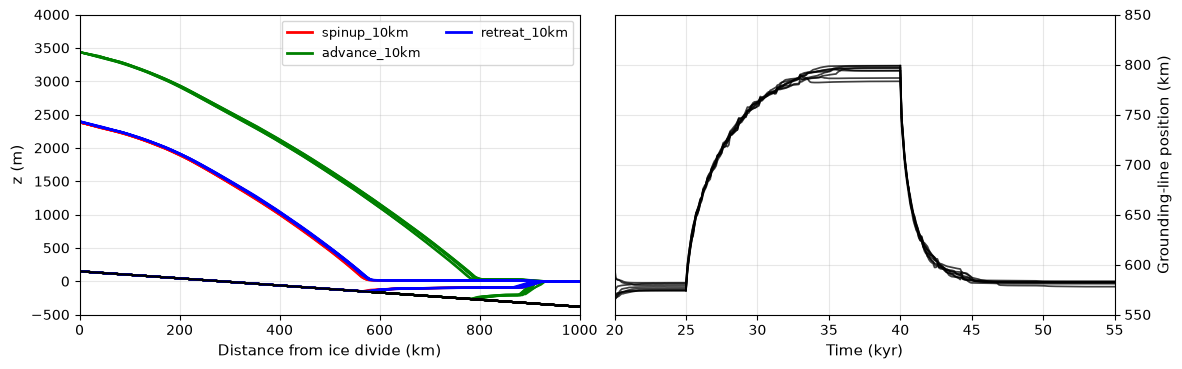
MISMIP_mod is a modified version of the flowline experiment from the first MISMIP paper (Pattyn et al., 2012). After initialising a steady-state ice sheet, the uniform flow factor is decreased, causing the grounding line to advance to a new steady state. Then, the flow factor is reset to its original value. Ideally, the grounding line should then retreat back to its original position. Any difference between the initial and final geometry is a numerical error - which Pattyn et al. showed can be quite substantial. UFEMISM's sub-grid friction scaling approach works quite well to reduce this error, so that even with a 10 km resolution, the hysteresis is almost negligible.

SSA Icestream

Fig_integrated_test_SSA_icestream_full_velocity
Fig_integrated_test_SSA_icestream_full_velocity.png

Keywords

Publications

Description

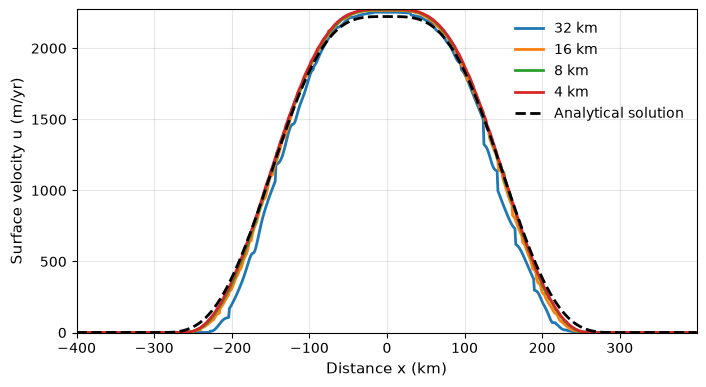
This experiment verifies UFEMISM's solution to the SSA in a slab-on-a-slope geometry, with laterally varying basal friction resulting in the formation of a confined ice stream. Schoof (2006) derived an analytical solution to the SSA for this case, to which we can directly compare the model.

ISMIP-HOM

Fig_integrated_test_ISMIP_HOM_full_A
Fig_integrated_test_ISMIP_HOM_full_A.png
Fig_integrated_test_ISMIP_HOM_full_B
Fig_integrated_test_ISMIP_HOM_full_B.png
Fig_integrated_test_ISMIP_HOM_full_C
Fig_integrated_test_ISMIP_HOM_full_C.png
Fig_integrated_test_ISMIP_HOM_full_D
Fig_integrated_test_ISMIP_HOM_full_D.png

Keywords

Publications

Description

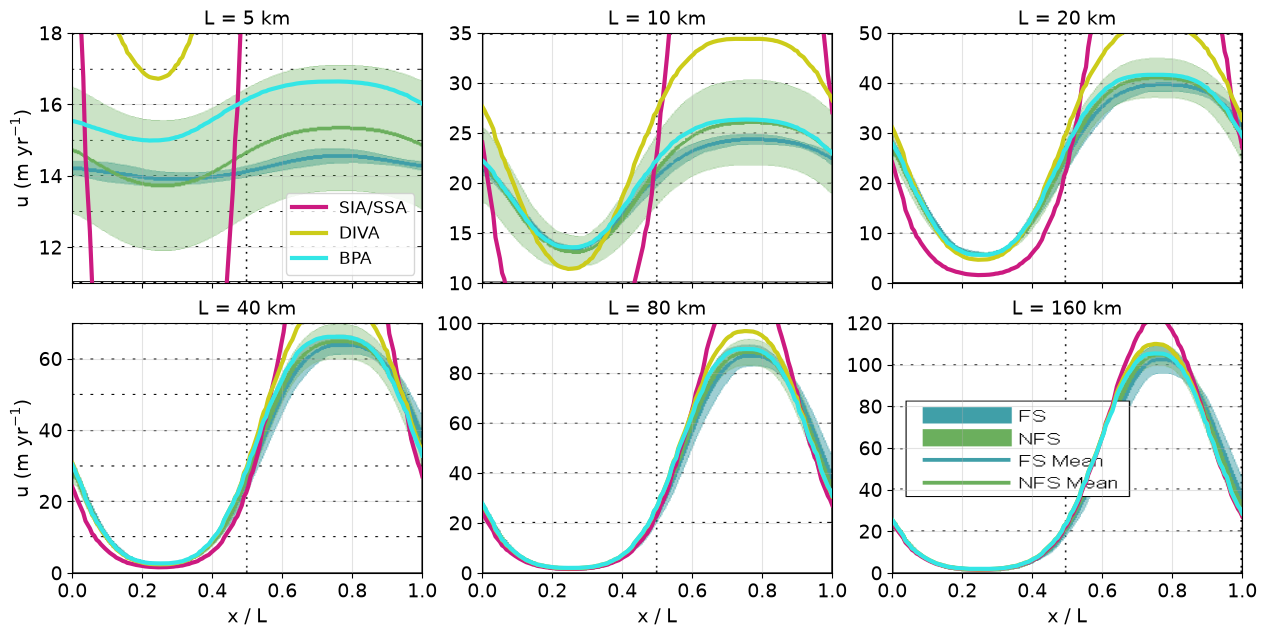
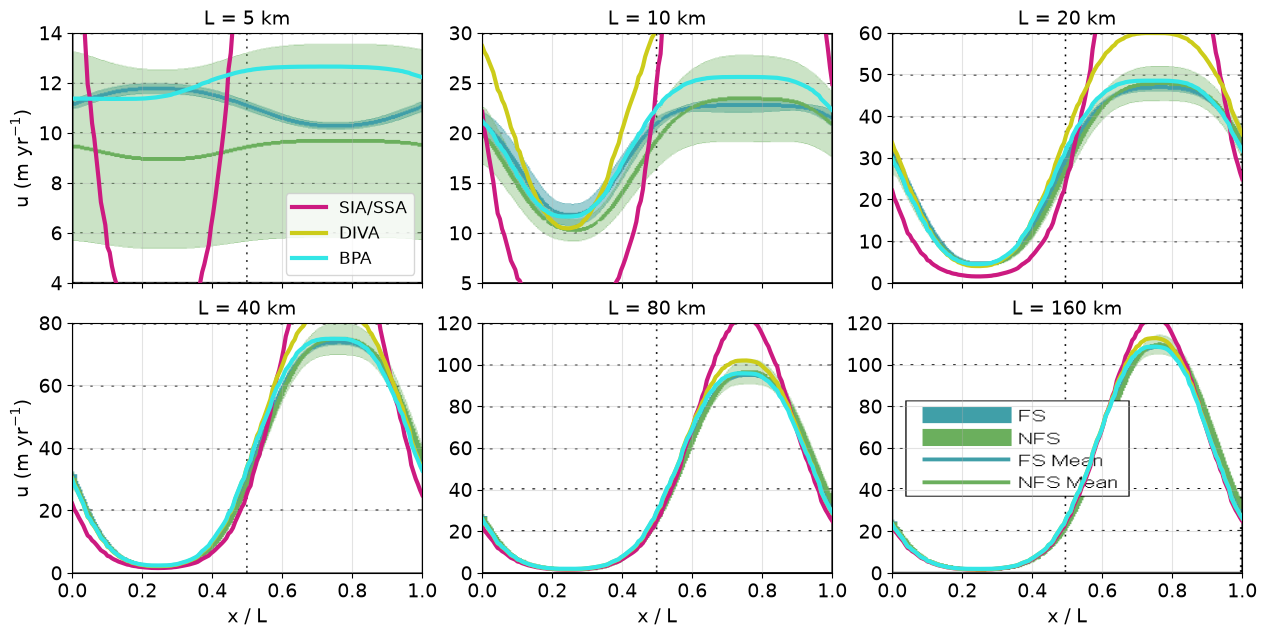
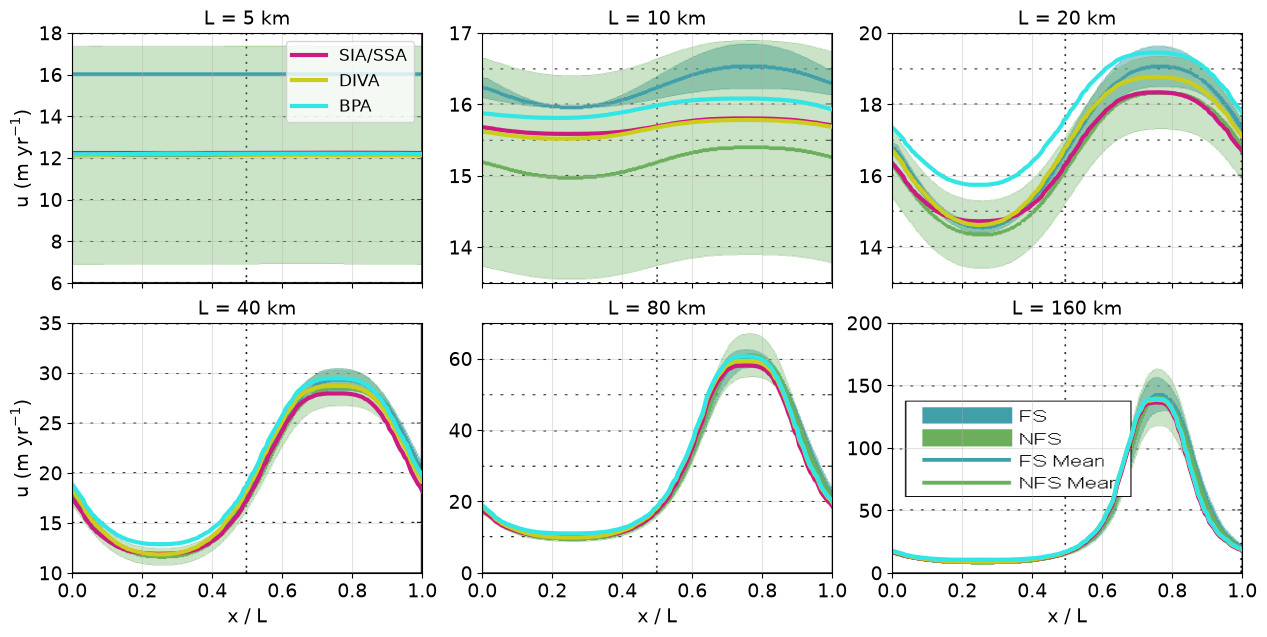
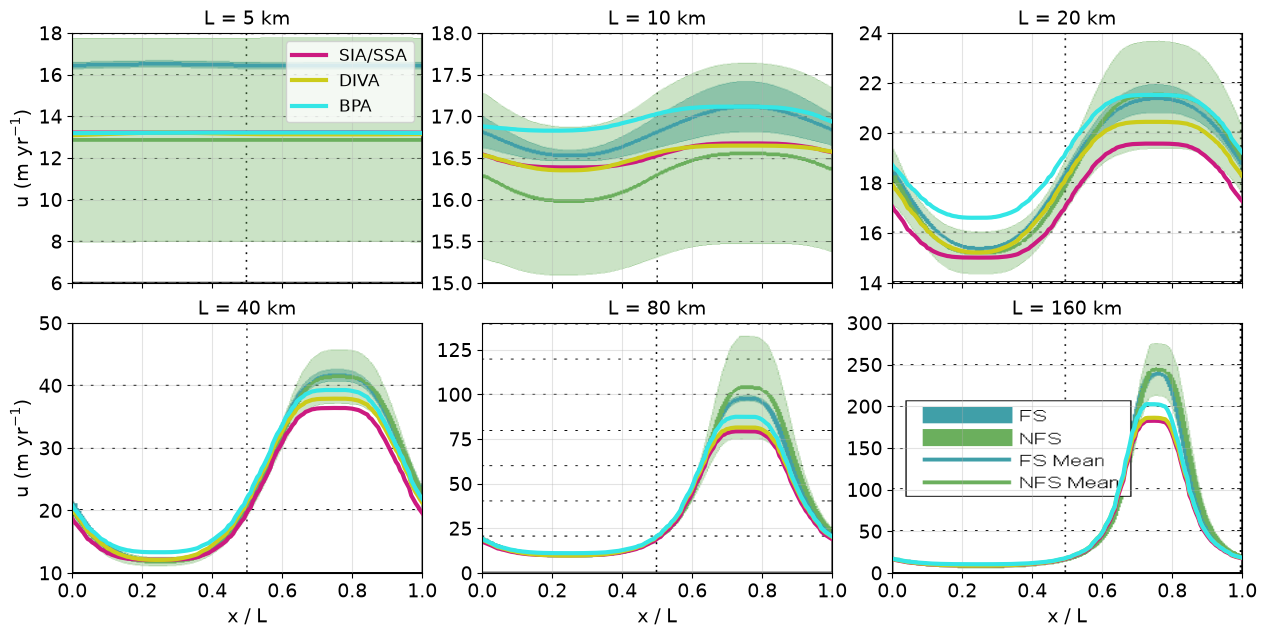
ISMIP-HOM is a benchmark experiment for higher-order and full-Stokes models. The idealised geometries are slab-on-a-slope, with periodic spatial variations in either the bed geometry or the basal friction coefficient. UFEMISM's Blatter-Pattyn solver generally agrees well with the ensemble results; the DIVA and particularly the hybrid SIA/SSA quickly deviate from the ensemble as the wavelength of the geometry/friction variations decreases.

Antarctica initialisation 01

Fig_integrated_test_Ant_init_full_01
Fig_integrated_test_Ant_init_full_01.png

Keywords

Description

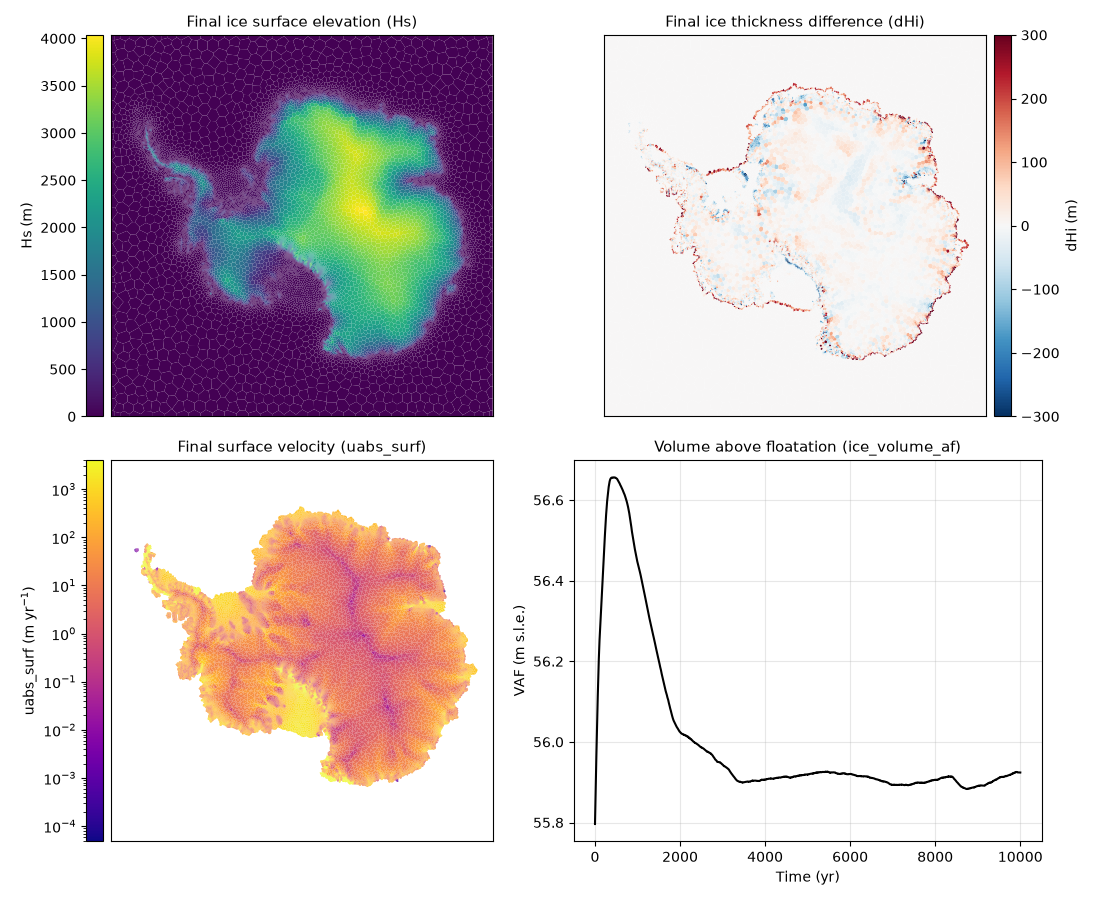
This is a low-resolution version of a basic Antarctic initialisation. It runs for 20,000 years, nudging the basal friction using the H_dHdt_flowline scheme. Sub-shelf melt rates are also nudged. The resulting ice sheet is quite stable, and shows a reasonable match to satellite observations.